

PLANET

BOOG 2025-03

General Information

BOOG number

BOOG 2025-03

Nickname

PLANET

Status

Date: 02/04/2026

Full title

PembroLizumab Adjuvant in patients with early-stage Triple NEgaTive breast cancer with residual disease after neoadjuvant pembrolizumab plus chemotherapy – the multicenter, randomized phase III, pragmatic PLANET trial

Indication

Description

Pembrolizumab adjuvant in TNBC patients

Target sample size

1000

Contact

Sponsor

NKI-AvL

Principal Investigator(s)

Dr. Marleen Kok (NKI-AvL)

Prof. dr. Gabe Sonke (NKI-AvL)

Prof. dr. Agnes Jager (Erasmus MC)

Study manager

Femke Verwer (Clinical Projects Manager NKI-AvL)

E: planet@nki.nl


Dr. Elise van Leeuwen-Stok (Clinical Study Manager BOOG Study Center)

Ilse Schilderinck, MSc (project assistant BOOG Study Center)

E: info@boogstudycenter.nl

T: 088-234 6730

Study coordinator

Dr. Annemiek van Ommen-Nijhof (NKI-AvL)

Drs. Robin van den Borg (NKI-AvL)

E: planet@nki.nl

Central datamanagement and registration

NKI-AvL

Monitoring

NKI-AvL

Local datamanagement

Centrum zelf of IKNL

Funding

ZE&GG / Ministry of Health

Stichting Treatmeds

Design

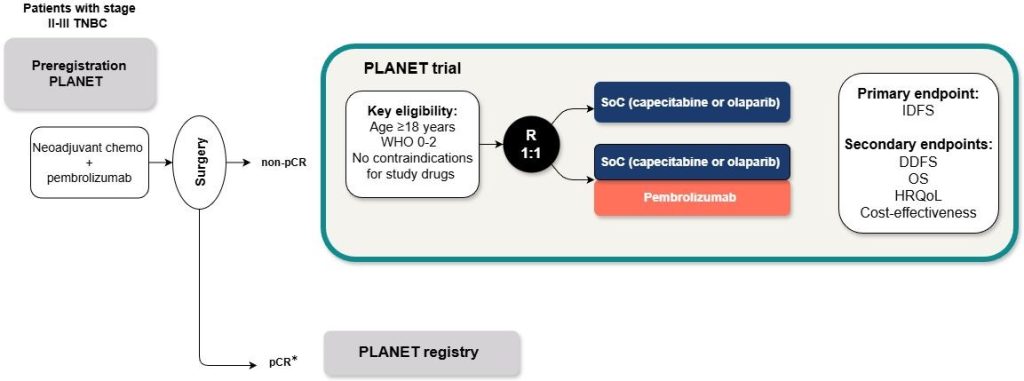
The PLANET trial is a randomized controlled phase 3 trial with two arms and a superiority design. Randomization will be stratified according to initial clinical disease stage (stage II versus III), residual tumor size (≥1cm or <1cm), prior platinum exposure and intended standard of care treatment (capecitabine versus olaparib).

Only participants with non-pCR are eligible for participation in the PLANET trial (see Chapter 7 of the protocol on detailed eligibility criteria); participants with pCR after neoadjuvant treatment will be followed through the PLANET pCR registry.


Participating sites


  • Admiraal de Ruyter Ziekenhuis
  • Albert Schweitzer Ziekenhuis
  • Amphia
  • Amsterdam UMC
  • Antonius Zorggroep
  • BovenIJ
  • Bravis
  • Canisius Wilhelmina Ziekenhuis
  • Catharina Ziekenhuis
  • Deventer Ziekenhuis
  • Diakonessenhuis
  • Dijklander Ziekenhuis
  • Elisabeth-TweeSteden Ziekenhuis
  • Erasmus MC
  • Franciscus Gasthuis & Vlietland
  • Frisius MC
  • Gelre Ziekenhuizen
  • Groene Hart Ziekenhuis
  • Haaglanden MC
  • HagaZiekenhuis
  • IJsselland
  • Ikazia
  • Isala
  • Jeroen Bosch Ziekenhuis
  • Laurentius Ziekenhuis
  • Maasstad Ziekenhuis
  • Maastricht UMC+
  • Martini Ziekenhuis
  • Maxima MC
  • Meander MC
  • Medisch Spectrum Twente
  • Nij Smellinghe
  • NKI-AvL
  • Noordwest Ziekenhuisgroep
  • OLVG
  • Ommelander Ziekenhuis
  • Radboudumc
  • Reinier de Graaf Gasthuis
  • Rijnstate Ziekenhuis
  • Rivas, Beatrix ziekenhuis
  • Rode Kruis Ziekenhuis
  • Slingeland Ziekenhuis
  • Spaarne Gasthuis
  • St. Anna Ziekenhuis
  • St. Antonius Ziekenhuis
  • St. Jans Gasthuis
  • Streekziekenhuis Koningin Beatrix
  • Tergooi MC
  • Treant
  • UMC Utrecht
  • UMCG
  • Van Weel-Bethesda Ziekenhuis
  • VieCuri MC
  • Wilhelmina Ziekenhuis Assen
  • Zaans MC
  • Ziekenhuis Amstelland
  • Ziekenhuis Gelderse Vallei
  • Ziekenhuis St. Jansdal
  • Ziekenhuisgroep Twente
  • ZorgSaam Ziekenhuis
  • Zuyderland MC


Objectives

Primary objective: 

To evaluate the value of adding adjuvant pembrolizumab to standard adjuvant treatment in patients with TNBC who have residual disease after neoadjuvant chemotherapy plus pembrolizumab


Secondary objectives: 

  • To evaluate the safety of adjuvant pembrolizumab
  • To evaluate the value of adjuvant pembrolizumab in specific subgroups (according to RCB and BRCA germline status)
  • To evaluate the effect of adjuvant pembrolizumab on HRQoL
  • To evaluate cost-utility of adjuvant pembrolizumab
  • To set up a registry that includes all patients with stage II-III TNBC who are intended to receive neoadjuvant chemotherapy plus pembrolizumab, and to compare outcomes in the registry with those in the RCT
  • Exploratory endpoints

Endpoints

Primary endpoint: 

The primary endpoint of the study will be invasive disease-free survival (IDFS), defined as time since randomization to local or distant breast cancer recurrence, second primary non-breast cancer or death due to any cause, whichever occurs first. Patients without any of these events will be censored at the time of the analysis.


Secondary endpoints include: 

  • Distant DFS (DDFS), defined as time from randomisation to distant recurrence or death due to any cause
  • Overall survival (OS), defined as time from randomisation to death due to any cause;
  • Safety/adverse events
  • Global health/QoL and physical functioning as measured by EQ-5D, EORTC QLQ C30 and EORTC QLQ-BR42
  • Cost-utility, based on the incremental cost-effectiveness ratio (ICER)

Eligibility Criteria

Main inclusion criteria:

  1. Male or female, ≥18 years of age on day of signing informed consent
  2. Stage II or III TNBC prior to the start of neoadjuvant treatment
    1. Locally assessed stage II or III TNBC according to the primary tumor (T) and regional lymph node (N) staging as per the American Joint Committee on Cancer (AJCC) for breast cancer staging criteria version 8
    2. Locally assessed estrogen receptor (ER) and/or progesterone receptor (PR) expression <10% and HER2-negative according to the ASCO-CAP guideline
  3. The patient has received neoadjuvant treatment with chemotherapy (containing at least anthracyclines and taxanes) and pembrolizumab, with a minimum of two 6-weekly (or four 3-weekly) cycles of pembrolizumab
  4. The patient underwent breast surgery ≤12 weeks prior to inclusion in the study
  5. The patient is scheduled to start standard of care adjuvant treatment with capecitabine or olaparib (pending reimbursement), based on non-pCR after neoadjuvant treatment, defined as RCB score >0
  6. World Health Organization (WHO) performance status 0-2
  7. Adequate organ function, as assessed ≤30 days prior to the screening:
    1. Absolute neutrophil count (ANC) ≥1,000/mm3 (1.0 x 10e9 /L)
    2. Platelets ≥50,000/mm3 (50 x 10e9 /L);
    3. Estimated creatinine clearance ≥ 30 mL/min as calculated using the method standard for the institution;
    4. Total serum bilirubin ≤1.5 x upper limit of normal (ULN) (≤3.0 x ULN if Gilbert’s disease);
    5. Aspartate aminotransferase (AST) and alanine transaminase (ALT) ≤3 x ULN
  8. Participants of childbearing potential must be willing to use an adequate method of contraception for the course of the study through 6 months after the last dose of study medication
  9. Willingness and ability to comply with scheduled visits, treatment plan, laboratory tests, and other study procedures
  10. Willingness to provide written informed consent, according to the Good Clinical Practice (GCP) and national/local regulations


Exclusion criteria:

  1. Contra-indications for any of the study drugs
  2. Other invasive malignancies, except when treated with curative intent without chemotherapy AND more than 5 years ago
  3. The presence of any psychological, familial, sociological or geographical condition potentially hampering compliance with the study protocol and follow-up schedule
  4. Any other severe acute or chronic medical or psychiatric condition or laboratory abnormality that may increase the risk associated with study participation or may interfere with the interpretation of study results and, in the judgment of the investigator, would make the patient inappropriate for entry into this study

Regulatory Information

EU CTR

2025-524229-41-00

EC approval

Yes
Date: 01/04/2026

EC

NedMec

Public Downloads

Downloads

Inloggen